Win Big and Help Shape the Future of the Pressure Washing Industry


By PWNA July 21, 2026

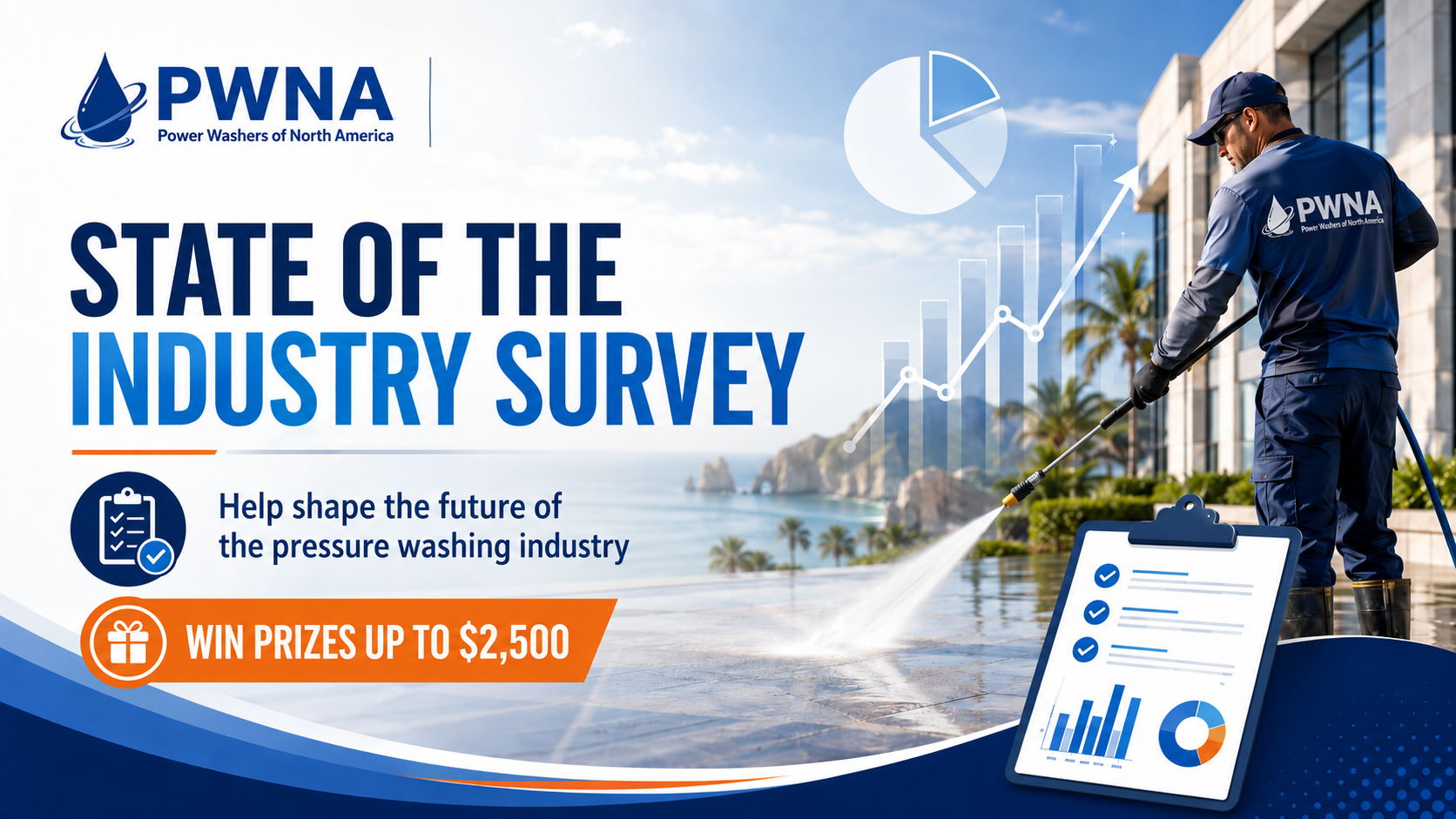
The pressure washing industry is constantly evolving, and the best way to stay ahead is by understanding what’s really happening on the ground. That’s why PWNA is conducting its State of the Industry Survey, and your voice plays a critical role in shaping what comes next.


Whether you're a solo operator just getting started or a seasoned contractor managing a growing team, your insights help paint a clearer, more accurate picture of the industry. From pricing trends and equipment preferences to business challenges and growth opportunities, every response contributes to a deeper understanding of where the industry stands today, and where it’s headed tomorrow.


Why Your Participation Matters


The information gathered through this survey will directly influence how PWNA develops future programs, resources, and member benefits. By sharing your experiences, you’re helping ensure that the education, training, and support offered by PWNA truly reflect the real-world needs of contractors like you.


Your feedback will also be compiled into the PWNA State of the Industry Report, a comprehensive overview of current trends and insights. This report will be presented at Elevate 2027, PWNA’s annual convention focused on education, certifications, and connecting professionals across the exterior cleaning industry.


What’s In It for You?


In addition to contributing to the growth and strength of the industry, participants will be entered for a chance to win a variety of valuable prizes, including:


  • One year of PWNA Enterprise Membership, two ELEVATE Convention passes, & three nights at Kalahari Resorts during convention, a $2,500 value
  • Two convention passes plus a $200 Double Cut Steak House gift card, an $800 value
  • A $100 Amazon gift card
  • Additional prizes and giveaways


These rewards are just a small token of appreciation for taking the time to share your perspective and help move the industry forward.


Be Part of Something Bigger


The more contractors who participate, the more accurate and impactful the results will be. Your input doesn’t just benefit PWNA, it helps strengthen the entire pressure washing community by providing valuable insights that can guide better decisions, smarter strategies, and stronger businesses.


No matter where you are in your journey, your experience matters. By taking a few minutes to complete the survey, you’re contributing to a stronger, more informed, and more connected industry.


Take the Next Step


Don’t miss your chance to make an impact and potentially win some great prizes. Take the survey today and help PWNA continue building better education, resources, and support for pressure washing professionals everywhere.

Share your experience. Strengthen the industry. Enter to win.


Get PWNA Updates in Your Inbox

Stay connected with industry training, safety reminders, event news, and resources for exterior cleaning professionals.

Contact Us

SHARE THIS

Latest Posts

By PWNA July 21, 2026
Each year, the Power Washers of North America celebrates the individuals and companies that go above and beyond for our industry. Whether they are raising the standard for professionalism and safety, supporting fellow contractors, or strengthening the exterior cleaning community, their contributions help move our industry forward—and they deserve to be recognized. Nominations are now open for the 2027 PWNA Awards , which will be presented at ELEVATE 2027 , the PWNA Annual Convention, taking place February 4–6, 2027, at Kalahari Resorts in Round Rock, Texas. How to Nominate You must be a current PWNA member to submit a nomination. Think of a contractor, vendor, employee, or industry professional whose leadership, service, or dedication has made a meaningful difference. Select the appropriate award category below and tell us why your nominee deserves to be recognized. Nominations are simple to submit and only take a few minutes. 2027 Award Categories PWNA Award of Excellence – Contractor Category Recognizes a PWNA contractor or company that demonstrates outstanding professionalism, safety, service, ethics, and community impact. Joseph Walters Award – Vendor Category Honors a PWNA industry vendor that provides exceptional support, builds strong relationships with contractors, and demonstrates an ongoing commitment to the PWNA community. Craftsman of the Year Celebrates a PWNA member employee whose craftsmanship, attention to detail, dedication to safety, and commitment to excellence set the standard for our industry. Phil Ackland Legacy Award Honors a kitchen exhaust cleaning contractor who demonstrates exceptional leadership, integrity, and professionalism, along with a strong commitment to fire prevention, life safety, education, and industry standards. Nomination Deadline: September 15, 2026 All nominations will be reviewed by the PWNA Board of Directors. Votes will be collected anonymously, and award recipients will be determined by a majority vote of the Board. In the event of a tie, the Board may conduct an additional vote or choose to recognize both candidates at its discretion. Help us shine a spotlight on the individuals and companies that represent the very best of our industry.  Nominate someone deserving today, and join us as we recognize the winners at ELEVATE 2027!
By Apellix Power Wash Drones June 18, 2026
JACKSONVILLE, Fla. — June 2026 — Apellix, the Jacksonville-based manufacturer of semi-autonomous drones, will host a free, hands-on demonstration of its Power Wash Drone at Pepperdine University in Malibu, California, on Saturday, July 25, 2026. Power washing contractors, exterior cleaning operators, and facility managers are invited to watch the drone clean a section of the iconic hillside campus, and then take the controls themselves. The Apellix Power Wash Drone cleans all commercial, residential and industrial exteriors (from windows, roofs, office buildings, hospitals, universities, solar panels, stadiums, etc.) without scaffolding, lifts, or ladders — reducing the time, cost, and liability of traditional exterior cleaning methods. It is NDAA-compliant and American-made. Attendees will also see a live demonstration of Apellix Intelligence (AI), including the company's AirShift and AirTrace autonomous features, as the drone cleans a pre-programmed section of the building hands-free. "Working at height shouldn't mean putting people at height. According to OSHA, 37% of construction fatalities in 2024 were fatal falls. Apellix would like to bring that number to zero. Keep window cleaners boots on the ground and send the drone to dangerous heights instead. " said Grace Dahlstrom, Chief of Staff at Apellix. "This event is built for the contractors and operators who do this work every day. We want them to see the drone fly, fly it themselves, and walk away with the real numbers on what drone cleaning means for their labor costs, their liability, and their ability to win bigger jobs." Founder Bob Dahlstrom has spoken at length about how cleaning drones can save lives and shares a poignant story about meeting a window cleaner whose father, also a window cleaner, fell to his death. Click here for the story. Event highlights include: Live demonstration of the Apellix drone cleaning a campus building Live demonstration of Apellix Intelligence (AI) autonomous cleaning features Hands-on, guided flight time alongside the Apellix team A breakdown of the economics: labor savings, reduced downtime, lower liability, and new revenue opportunities Insights on getting started, including financing, training, and support Q&A with the Apellix team and networking with operators, facility leaders, and industry innovators Event details: What: Apellix Autonomous Cleaning Drone Demonstration in partnership with Pepperdine University When: Saturday, July 25, 2026 Where: Pepperdine University, Malibu, CA Cost: Free; space is limited 
By Apellix Power Wash Drones June 18, 2026
If you run a pressure washing or exterior cleaning company, you have probably watched the same problem play out on every mid-rise and high-rise bid: the work is up there, and getting to it is expensive, slow, and dangerous. Lifts, swing stages, rope access, and scaffolding can consume more of a job's budget than the cleaning itself, and falls from height remain one of the most persistent safety risks in our industry. OSHA sites construction related fatalities as 37% caused by fatal falls and it’s similar pressure washing at height. Drone cleaning changes that math. A spray-capable drone tethered to a ground-based pump can soft wash or pressure wash building exteriors, windows, roofs, tanks, and stadiums while every member of the crew keeps their boots on the ground. What was a niche curiosity a few years ago is now a maturing service category, and 2026 is arguably the best time yet to enter it: the technology has stabilized, training programs exist, and most regional markets still have little or no drone cleaning competition. Here is what you need to know to launch a drone cleaning business or add drone services to an existing exterior cleaning company. Why Drones, and Why Now The value proposition rests on three pillars: Safety. Crews stay on the ground instead of working at height. No swing stages, no rope access, and dramatically reduced fall exposure, which also tends to mean better insurance conversations. Speed. Jobs that took days with lifts or scaffolding can often be completed in hours. There is no equipment mobilization for aerial access, and setup time is measured in minutes. For example, CleanFlight Solutions in St. Petersburg Florida cleaned the Raymond James headquarters in 11 hours using an Apellix Power Wash Drone, when the job conventionally took 11 days. Access economics. Mid-rise buildings (roughly 3 to 15 stories) are the sweet spot, too tall for extension poles, but where traditional access costs make conventional cleaning painful. Many of these properties are simply cleaned less often than they should be because access is so expensive. That is latent demand. Tile roofs are also a sweet spot where homeowners don’t want someone accidentally stepping on, and cracking a tile. Demand-side momentum is real, too. Property managers, HOAs, municipalities, and facility managers increasingly ask for drone services by name, both for the cost savings and because it photographs and markets extremely well. The Drone Girl reported on a story where the Blue Cross Blue Shield RFP specifically requested drone cleaning. How Drone Cleaning Actually Works Purpose-built cleaning drones do not carry water onboard; water is far too heavy. There is a 55lb weight limit set by the FAA so the drone plus the water and tether must stay under 55lbs. Instead, the drone flies with a hose tether connected to a ground-based pump, drawing soft wash chemicals or pressurized water from below. The pilot (and in most setups a visual observer) operates from the ground, positioning the drone's spray nozzle against the work surface. Capabilities vary significantly by platform: working reach ranges from about 150 feet to nearly 200 feet on leading purpose-built systems, pressures run from soft wash levels up to 4,000+ PSI, and flight times per battery range from under 20 minutes to over 30. Some platforms now include autonomy features like AirTrace, which reduces pilot fatigue and improve consistency on large facades. Step 1: Get Legal — FAA Part 107 and Beyond Commercial drone operation in the U.S. requires an FAA Part 107 Remote Pilot Certificate. The good news: it is a knowledge test, not a flight test. Plan on a few weeks of study (aeronautical charts, airspace classes, weather, regulations), a roughly $175 testing fee, and you are certificated. Each pilot on your team who flies commercially needs one. Beyond Part 107, build these into your operating plan: Most cleaning drones exceed the 55-pound threshold only rarely, but verify your platform's takeoff weight with full tether and rigging. Heavier configurations can require additional FAA authorization. Airspace authorizations (LAANC) for jobs near airports, most are instant approvals through apps, but check before you quote, not after. State and local rules. Some municipalities have their own drone ordinances, and wastewater/runoff rules for cleaning chemicals apply to drone work just as they do to ground-based washing. Drone registration. Every commercial aircraft must be registered with the FAA. Step 2: Choose Your Platform This is the largest decision you will make, and the market has consolidated meaningfully. A few years ago, operators commonly modified off-the-shelf camera drones (most famously the DJI Matrice 300 RTK) with aftermarket spray kits. That path is closing: new DJI enterprise aircraft are no longer readily available for purchase in the U.S. after the FCC cracked down on foreign-made drones, and DIY conversions come with reliability, support, and liability tradeoffs that are hard to justify for a business built on uptime. In 2026, the practical choice for most new operators is between purpose-built American platforms. The comparison chart below summarizes the current landscape across the factors that matter most: price, reach, pressure, training, battery life, and NDAA compliance (which determines eligibility for government and many institutional contracts). A few buying notes beyond the spec sheet: NDAA compliance is a revenue gate. Government, military, utility, and certain facility contracts require a NDAA-compliant aircraft. If ports, highways, courthouses, universities or other government work is in your plan, this is non-negotiable. Training is part of the price. Factor in what it costs to get your second and third pilots certified on the equipment, not just the first. Reach defines your market. A drone that reaches 195 feet bids a different building than one that reaches 150 feet. Step 3: Insurance and Risk Management Standard pressure washing liability policies generally do not cover aircraft operations. You will need aviation liability coverage (commonly $1M–$5M depending on the buildings you target) plus hull coverage for the drone itself. Several insurers now specialize in commercial drone operations, and some offer on-demand per-flight coverage that works well while you ramp up. Expect commercial property managers to require certificates of insurance naming them as additional insured, same as ground work, just with the aviation layer added. Build a written operations manual: pre-flight checklists, weather minimums (wind is your main constraint, most spray work wants sustained winds under roughly 15 mph), tether management procedures, and emergency protocols. Beyond reducing risk, a documented safety program is always a good idea. Step 4: Pricing and Services Drone cleaning commands a premium over ground-based work because you are replacing far more expensive access methods. Common service lines and how operators typically price them: Building soft washing (the core service): typically priced per square foot of facade, with rates increasing for a difficult to reach area like a building next to a retention pond. Window cleaning for mid-rise commercial properties, often on recurring contracts. Roof cleaning, especially steep, fragile, or high roofs that are dangerous to walk. Specialty work: water towers, stadiums, signage, solar arrays, storage tanks, and post-construction cleanup. When quoting, anchor against the client's alternative. If a lift rental plus a three-day crew runs $15,000, a one-day drone job at $9,000 is an easy yes, and a healthy margin for you. Recurring maintenance contracts (quarterly or semi-annual washes) are where the business model really shines, because buildings that were washed every five years for cost reasons can now be maintained annually. Step 5: Marketing That Works for Drone Services Drone cleaning is the rare service that markets itself on video. Some companies like Apellix offer free, basic marketing material along with drone purchase so be sure to check you’re your drone manufacturer. Prioritize: Job-site footage. Every job is content. A 30-second clip of a drone washing a six-story facade outperforms any brochure. Direct outreach to property managers, HOA boards, and facility directors. BOMA and IFMA chapter events are good places to meet them. Your existing customer base, if you are adding drones to a pressure washing company. The buildings you already wash at ground level have upper floors nobody is cleaning. Industry credibility. PWNA membership, manufacturer certifications, and documented safety programs all close institutional deals. A Realistic Launch Timeline Study for and pass the FAA Part 107 exam; register your aircraft. Select and purchase your platform; complete manufacturer training. Secure aviation liability and hull insurance; write your operations manual. Fly practice jobs and capture video. Launch with introductory pricing for 3–5 anchor clients, then raise rates as your portfolio builds. The capital requirement is real — plan on 75,000 all-in for a purpose-built platform, training, insurance, ground rig (which is usually $25,000) and working capital. The Bottom Line Exterior cleaning is moving up the building, and drones are how it gets there safely. The regulatory path is well-marked, the equipment has matured into reliable purpose-built platforms, and demand from property managers is ahead of supply in most markets. For pressure washing professionals, drone cleaning is not a replacement for what you do. It is the same business you already know, with new technology. 2026 is the year the early movers separate from the pack. The question is whether you will be one of them. About Apellix Apellix is a Jacksonville, Florida-based aerial robotics company that designs and manufactures American-made drones for industrial cleaning, soft washing, power washing, spray painting, coating, and inspection. Their drone systems are built to help contractors work safer and more efficiently by reducing the need for ladders, lifts, scaffolding, and rope access on high-risk jobs. With technology used in commercial, industrial, and government applications, Apellix is helping advance the future of exterior cleaning through safer, smarter robotic solutions. Learn more at Apellix.com
By Shelby Bryan March 31, 2026
Running a pressure washing business means focusing on the job in front of you, not getting buried in insurance language. Still, having the right coverage plays an important role in protecting your business.
By PWNA March 16, 2026
The jobs are already out there. The only question is whether your equipment is ready to take them. Spring doesn't ease in for exterior cleaning contractors. One week you're slow, and the next your voicemail is full and your estimate calendar looks like a game of Tetris. There's no warm-up period. No dress rehearsal. The season opens hard, and whoever's standing at the plate with a working rig and stocked chemicals gets the at-bats. That's the whole game. At PWNA, we talk a lot about what it...
By PWNA March 10, 2026
As members of the Power Washers of North America (PWNA), attaining certification and training in the specialized area of pressure washing endows you with a distinct competitive edge. In today's digital age, discerning consumers extensively research via the internet and other resources to identify contractors who are not only reputable but also possess advanced training, thereby ensuring the protection of their property and the efficient use of their time. To this end, the PWNA provides a...
Show More