Changes in Solar Array Voltages Increases Risks to Solar Panel Cleaners- What Do You Need to Know?
By Steve Williams- ISCA • November 4, 2026

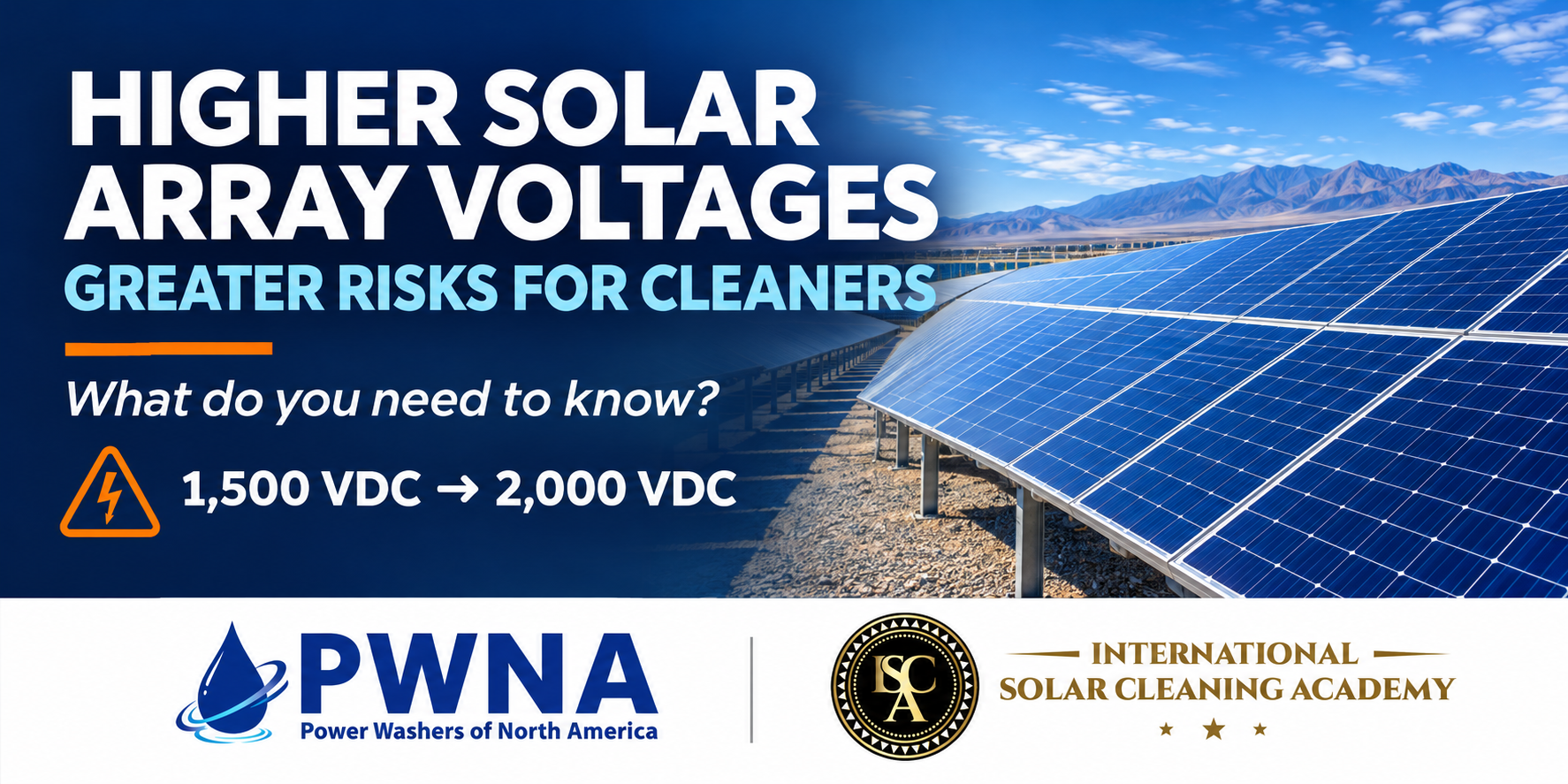
As photovoltaic technology moves from 1,500 VDC toward systems rated up to 2,000 VDC, solar cleaning businesses need to review their equipment, working methods and electrical safety training. The consequences of getting it wrong can be fatal.
Solar panel cleaners can no longer assume that 1,500 volts DC represents the highest system voltage they may encounter on a utility-scale installation.
In March 2025, Sungrow reported that it had deployed a 2,000 VDC photovoltaic system inShaanxi, China. Electrical connector manufacturer Stäubli also offers photovoltaic connectorsapproved for up to 2,000 VDC. Higher voltage solar technology is already a reality, rather than simply a future possibility.
This does not mean that every solar farm now operates at 2,000 VDC, or that this voltage has become universally permitted across US installations. It means that cleaning contractors need to verify the electrical characteristics of each site rather than rely on previous assumptions.
A 33% increase- but in what?
The increase from 1,500 to 2,000 VDC is 33.3% in voltage.
At the same operating current, a 33.3% increase in operating voltage also means a 33.3% increase in electrical power, because power equals voltage multiplied by current.
However, a maximum system voltage rating is not the same as actual operating voltage. Higher voltage designs allow longer series strings; they do not make each individual panel generate 33.3% more power. Actual output depends on the system configuration and operating conditions.
For cleaners, the safety concern is the increased electrical potential and the need for protective measures suited to it. It would be inaccurate to claim that electrocution risk or arc-flash severity automatically increases by exactly 33.3%.
Why should cleaners be concerned?
Solar cleaners work close to electricity-generating equipment, often while handling water and long poles. Damaged insulation, defective connectors or exposed wiring can turn an apparently routine cleaning task into an electrical incident.
Higher voltage can drive greater current through an unintended conductive path, depending on its resistance and the source’s characteristics. Wet contact conditions can reduce the body’s electrical resistance and increase the danger. Both 1,500 VDC and 2,000 VDC systems can present fatal electrical hazards.
The principal risks include:
- Electric shock and fatal electrocution. Direct contact with exposed live parts—or indirect contact through conductive equipment—can put a worker in the electrical circuit.
- Arc flash and severe burns. Electrical arcing can cause life-changing or fatal injuries. Voltage alone cannot determine the severity of a particular event.
- Falls following electrical exposure. A shock or sudden reaction can cause a cleaner to lose balance on a roof, ladder or elevated platform. The resulting fall can be fatal.
Higher voltage also demands a review of equipment suitability. A protective item rated only for 1,500 VDC cannot automatically be relied upon at 2,000 VDC. Nor should an ordinary pole, grip or pair of gloves be assumed to provide electrical insulation.
OSHA specifically addresses long conductive objects and conductive cleaning materials near exposed energized parts in 29 CFR 1910.333(c)(6) and (c)(9). These are particularly relevant considerations when assessing solar cleaning methods.
"We only clean the panels"- Does training Still apply?
Where OSHA’s general-industry electrical safety rules apply, the answer depends on the worker’s exposure, rather than their job title.
29 CFR 1910.332(a) states:
“The training requirements contained in this section apply to employees who face a risk of electric shock that is not reduced to a safe level by the electrical installation requirements of §§ 1910.303 through 1910.308.”
Under 1910.332(b)(1):
“Employees shall be trained in and familiar with the safety-related work practices required by §§ 1910.331 through 1910.335 that pertain to their respective job assignments.”
Crucially, 1910.332(b)(2) also covers unqualified persons:
“Employees who are covered by paragraph (a) of this section but who are not qualified persons shall also be trained in and familiar with any electrically related safety practices not specifically addressed by §§ 1910.331 through 1910.335 but which are necessary for their safety.”
Section 1910.332(c) adds:
“The degree of training provided shall be determined by the risk to the employee.”
Being a cleaner rather than an electrician does not, by itself, remove the training obligation.
What should cleaning businesses do?
Before accepting or starting work, obtain reliable confirmation of the site’s maximum DC voltage and review the proposed cleaning method with the responsible site personnel.
That review should consider equipment suitability, water use, access beneath modules, foreseeable electrical defects and clear stop-work procedures. Suspected electrical faults should be referred to the responsible qualified electrical professional.
Do not assume that turning off the inverter or AC supply makes the array electrically safe. Illuminated PV modules can continue generating DC electricity after AC shutdown. Where electrical isolation is required, appropriate isolation and verification procedures must be followed.
Arc-flash PPE must also be selected through an appropriate assessment. There is no universal protective clothing or face-shield calorie rating that can be safely chosen simply because an array is rated at 2,000 VDC. PV arc-flash assessment requires consideration of the particular circuit and fault conditions.
Keep training in step with the industry
For PWNA and IWCA members reviewing their training arrangements, the International Solar Cleaning Academy’s Solar Panel Cleaning Technician (ISCA SPCT) training offers a starting point for developing solar cleaning safety knowledge, alongside instruction specific to the site, equipment and assigned tasks.
Employers should confirm that their chosen training addresses the voltage levels and hazards their teams may encounter. Course completion alone does not establish electrical qualification or full OSHA compliance.
Solar technology is advancing. Cleaning practices, equipment selection and worker training need to keep pace. Before the next job, verify the voltage—and make sure the team understands the hazards it will face.
About the author
Steve Williams is the founder of the International Solar Cleaning Academy (ISCA), an organization dedicated to advancing safety, professionalism, and technical standards in solar panel cleaning. With more than 15 years of industry experience, Steve helps contractors develop the knowledge and skills to work safely and grow their businesses. Through education, certification, and practical resources, ISCA supports solar cleaning professionals worldwide.
Contact ISCA at info@theisca.org or (737) 359-5565, or visit theisca.org.
Get PWNA Updates in Your Inbox
Stay connected with industry training, safety reminders, event news, and resources for exterior cleaning professionals.
Contact Us
We will get back to you as soon as possible.
Please try again later.
SHARE THIS
Latest Posts